
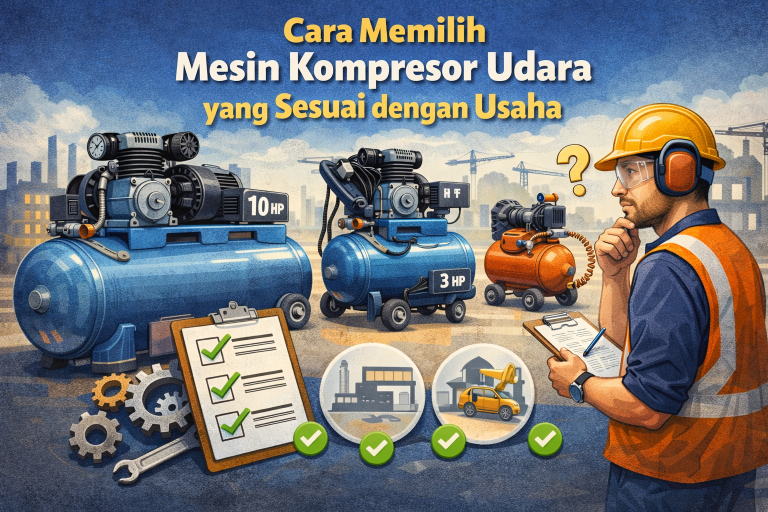

How to Choose the Right Air Compressor for Your Business
Do you run a business and need an air compressor, but feel confused about which one to buy?
Let’s break it down and clearly explain which type of air compressor is best suited for your business needs.
Why a Screw Air Compressor — and What Are Its Advantages?
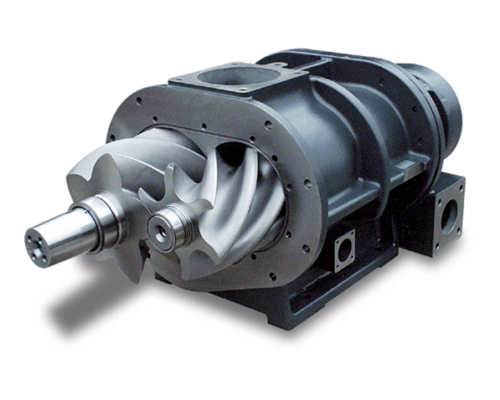
A Rotary Screw Air Compressor works using two intermeshing rotors (screws) that rotate to compress air—unlike piston compressors that rely on cylinders and pistons. (Atlas Copco)
Because of this design, screw compressors are ideal for continuous-duty operations, providing a stable air supply, higher efficiency, and relatively simpler maintenance compared to piston compressors. (Atlas Copco)
That’s why for industrial, manufacturing, production, or workshop applications that require stable compressed air, screw-type compressors are often the best choice.
In short: if your business needs reliable compressed air over long periods with medium to heavy workloads, a screw compressor is usually more suitable than a piston compressor.
Key Parameters You Must Calculate Before Choosing a Compressor
Before purchasing, it’s crucial to calculate your actual air demand—so you don’t end up under-spec’d (insufficient power) or over-spec’d (wasting money and energy).
Here are the main parameters to consider:
1. Air Demand (Flow / Volume)
Usually measured in CFM (cubic feet per minute), m³/min, or LPM.
If the compressor’s air output is insufficient, pneumatic tools will struggle, pressure will drop, and production can be disrupted. (Sollant)
Best practice: add up the air requirements of all tools and include an extra 10–20% safety margin. (Minnuo Compressor)
2. Working Pressure
Measured in bar or PSI.
Certain tools or processes require a minimum pressure to function properly.
Too low → tools won’t operate correctly
Too high → energy waste and potential equipment damage
(Worthington Creyssensac)
For most general industrial applications, 0.6–0.8 MPa (6–8 bar) is sufficient. (Sollant)
3. Duty Cycle / Usage Pattern (Continuous vs Intermittent)
If your operation runs continuously (long shifts or 24/7 production), choose a compressor designed for heavy-duty continuous operation. (Worthington Creyssensac)
If usage is intermittent or fluctuating, consider models with energy-saving features such as variable speed control. (SmartBuy)
4. Energy Efficiency / Power Consumption
Since compressors often run for long hours, electricity consumption becomes a major operating cost.
High-efficiency compressors can significantly reduce long-term energy expenses. (Worthington Creyssensac)
5. Compressor Type & Supporting Features
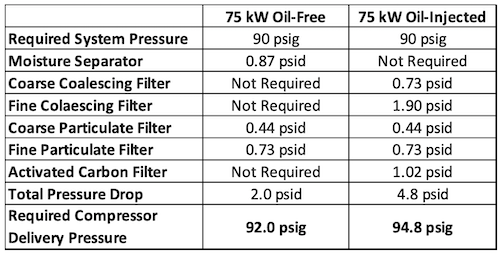
Oil-free compressors
Ideal when air purity is critical (pharmaceuticals, food & beverage, electronics) because there is no oil contamination risk. (Atlas Copco)Oil-injected compressors
More common, lower initial cost, and suitable for most general industrial applications. (Atlas Copco)Cooling system (air-cooled vs water-cooled)
Depends on the working environment and load. In hot environments or heavy-duty operations, water-cooled systems are often more stable. (SmartBuy)Control systems & accessories
Features such as VSD (Variable Speed Drive), automatic controls, air dryers, filters, and receiver tanks improve efficiency, convenience, and air quality. (Sollant)

Practical Steps to Choose the Right Compressor
1. Inventory all tools and processes
List every pneumatic tool or machine that uses compressed air. Note their required airflow (CFM / m³/min) and pressure (bar / PSI).
Add a 10–20% safety margin to handle peak loads and future production growth.
2. Define your usage pattern
Continuous operation → choose a heavy-duty screw compressor
Fluctuating demand → consider VSD models for better energy efficiency
3. Choose based on air quality requirements
Clean air needs (food, pharma, electronics, labs) → oil-free screw compressor
General manufacturing → oil-injected screw compressor is sufficient and more cost-effective
Also consider air-cooled vs water-cooled systems based on ambient temperature and workload.
4. Calculate total cost of ownership
Initial purchase price alone can be misleading.
A cheaper compressor may become expensive over time due to:
High electricity consumption
Frequent maintenance
Low efficiency
A properly sized, energy-efficient compressor can save substantial costs in the long run.
5. Check vendor support & after-sales service
Industrial machines must be reliable.
Ensure the supplier provides:
After-sales service
Spare parts availability
Technical documentation
Warranty and service support
Risks of Choosing the Wrong Compressor — and Why Accuracy Matters
Under-sized capacity → pressure drops, tools underperform, production disruptions
Over-sized capacity → excessive electricity costs, wasted energy, higher investment and maintenance costs
Wrong type selection (e.g., oil-injected when clean air is required) → oil contamination risks, damaged products, failure to meet quality standards (especially in food, pharma, and electronics)
Ignoring usage patterns → faster wear, shorter machine lifespan, frequent breakdowns, and high downtime
In short, choosing a compressor is not just about price or brand popularity—it must be aligned with your technical and operational requirements.
Recommended Mindset When Choosing an Air Compressor
Treat compressor selection as a system design process, not guesswork
Avoid over-specifying “just to be safe”—consider long-term operating costs
Focus on efficiency and suitability, not just higher capacity or power
Involve technicians or engineers to validate air demand, piping layout, pressure levels, and future usage plans
Still Unsure Which Compressor Is Right for You?
Consult with our technical experts to help you choose the right air compressor—without the risk of under- or over-specification.
👉 Click HERE to consult with our technicians.