
Complete Guide for Factories & Workshops
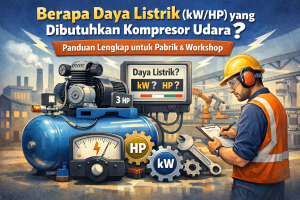
Choosing an air compressor should not be based solely on price or air capacity (CFM). One of the most critical factors—yet often overlooked—is electrical power (kW/HP). Miscalculating power requirements can lead to excessive electricity consumption, frequent electrical trips, and a shortened compressor lifespan.
This article provides a complete guide on how to determine the correct electrical power for air compressors used in factories and workshops.
1. What Is Air Compressor Power Consumption?
Air compressor power refers to the amount of electrical energy required by the motor to generate compressed air. It is commonly expressed in:
-
HP (Horsepower)
-
kW (Kilowatt)
1 HP ≈ 0.746 kW
However, in real industrial applications, actual power consumption is usually higher than theoretical values due to factors such as:
-
Motor efficiency
-
Operating load
-
Cooling system
-
Electrical installation conditions
2. Relationship Between Pressure, Air Capacity, and Power
Compressor power consumption does not stand alone; it is influenced by several factors:
a. Working Pressure (Bar / PSI)
The higher the required pressure, the greater the electrical power needed.
b. Air Capacity (CFM / m³/min)
The larger the air demand, the larger the compressor motor required.
c. Compressor Type
-
Piston compressor → lower power, suitable for intermittent use
-
Screw compressor → stable power consumption, suitable for continuous operation
-
Variable Speed Drive (VSD) → power adjusts according to actual demand
3. Estimated Compressor Power Based on Size
Below is a general estimation:
| Motor Power | kW Approx. | Typical Application |
|---|---|---|
| 3 HP | ±2.2 kW | Small workshop |
| 5 HP | ±3.7 kW | Garage, spray painting |
| 7.5 HP | ±5.5 kW | Light production |
| 10 HP | ±7.5 kW | Medium workshop |
| 20 HP | ±15 kW | Small factory |
| 30 HP | ±22 kW | Medium factory |
| 50 HP | ±37 kW | Large industry |
| 100 HP | ±75 kW | Heavy-duty factory |
⚠️ Important note:
The required utility power supply is usually 10–20% higher than the motor’s rated power.
4. Example of Electrical Power Calculation
Workshop Case Study
-
Compressor: 10 HP
-
Motor power: ±7.5 kW
-
Efficiency & safety factor: +15%
Recommended electrical power:
7.5 kW + 15% = ±8.6 kW
This means:
-
Three-phase electricity is highly recommended
-
Minimum utility capacity: 11,000 VA – 13,000 VA
5. Single Phase vs Three Phase: Which Is Better?
Single Phase
✔ Suitable for 1–5 HP
❌ Unstable for heavy loads
❌ Higher risk of overheating and voltage drop
Three Phase
✔ Stable operation
✔ Higher efficiency
✔ Longer motor lifespan
🔧 For compressors above 7.5 HP, three-phase power is mandatory.
6. Impact of Compressor Type on Power Consumption
Piston Compressor
-
Fluctuating power consumption
-
Suitable for non-continuous operation
Fixed-Speed Screw Compressor
-
Stable power consumption
-
Inefficient during low-load operation
VSD Screw Compressor
-
Power consumption follows actual demand
-
Energy savings of 20–35%
-
Ideal for factories with variable air demand
7. Common Mistakes When Determining Compressor Power
❌ Relying only on the HP rating on the nameplate
❌ Ignoring starting current
❌ Selecting utility power capacity too close to the limit
❌ Not considering future production expansion
These mistakes often result in:
-
Frequent circuit breaker trips
-
Motor overheating
-
Rising electricity costs
8. Tips to Reduce Compressor Electricity Consumption
✔ Use a VSD (inverter)
✔ Use high-quality compressor oil
✔ Perform regular maintenance
✔ Eliminate air leaks
✔ Use only the required pressure (avoid over-pressurizing)
9. Conclusion
Determining the correct air compressor power (kW/HP) must consider:
-
Air capacity requirements
-
Working pressure
-
Compressor type
-
Electrical system at the site
Do not focus only on HP—focus on real operational needs.
The right selection will result in:
-
Lower electricity costs
-
More stable production
-
Longer machine lifespan
🔧 Free Consultation
If you are unsure about choosing the right electrical power for your factory or workshop air compressor, it is best to consult before purchasing to avoid specification errors.
Call Us